


Home / Lifestyle
Rocky planet found in unexpected orbit challenges planet formation theories
The discovery supports a new 'inside out' model of sequential planet formation
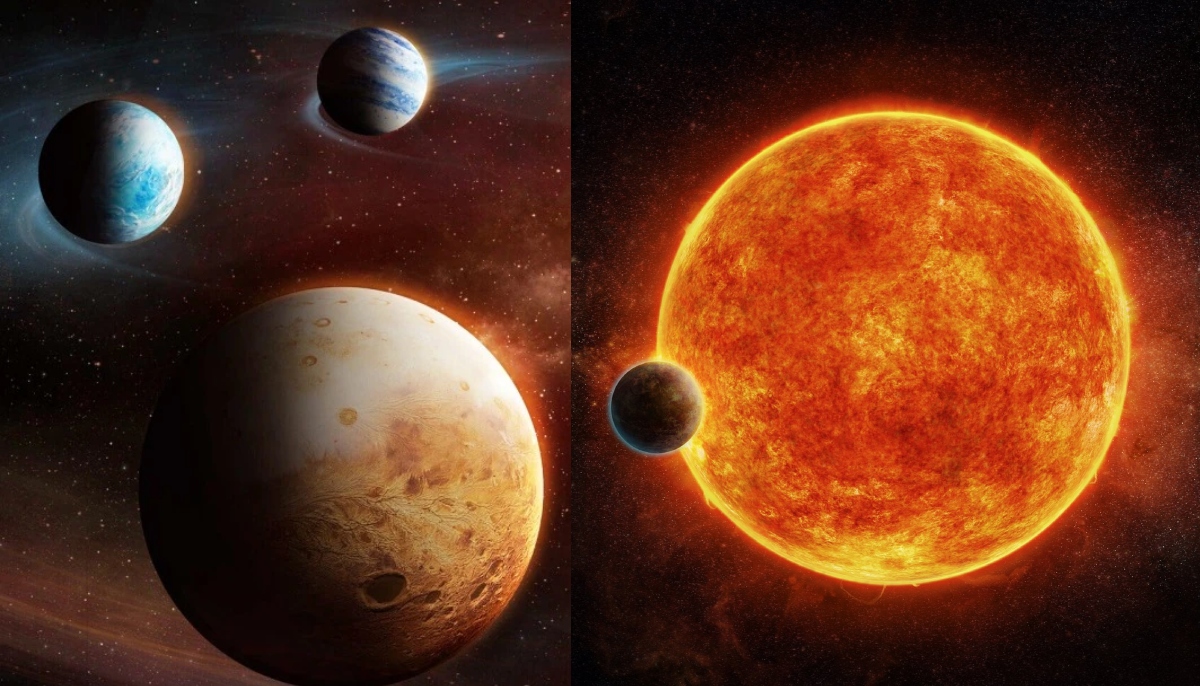
Ryan Cloutier and his team have discovered a rocky planet in an unexpected location, challenging traditional ideas about how planetary systems form.
The newly identified planet, LHS 1903 e, orbits the red dwarf star LHS 1903 at the outer edge of its system, defying the familiar pattern in which small, rocky planets form close to a star while distant worlds become gas giants.
Scientists initially observed three planets orbiting LHS 1903: a rocky planet nearest the star, followed by two Neptune-like gas giants, consistent with standard models.
Years of observations using telescopes on Earth and the European Space Agency’s CHEOPS satellite revealed the fourth planet, a distant rocky world.
“We’ve seen this pattern: rocky inside, gaseous outside, across hundreds of planetary systems. But now, the discovery of a rocky planet in the outer part of a system forces us to rethink the timing and conditions under which rocky planets can form,” Cloutier said.
The research team ruled out other possibilities, such as massive collisions stripping away atmospheres or orbital migration, swapping planetary positions.
Instead, they suggest that planets in the LHS 1903 system may have formed sequentially rather than simultaneously.
This “inside out” formation theory posits that the composition of a planet depends on the local environment at the time it develops, explaining why LHS 1903 e remained rocky despite its distant orbit.
“This is remarkable a rocky world forming in an environment that shouldn’t favor that outcome. It challenges the assumptions built into our current models,” Cloutier said.
He added that the finding may signal a new class of planetary systems that do not conform to the familiar solar system blueprint.
The discovery highlights the diversity of planetary systems in the Milky Way and underscores how improved telescopes and detection methods are reshaping scientists’ understanding of how worlds form and evolve.
“Each new system adds another data point to a growing picture of planetary diversity, one that forces scientists to rethink the processes that shape worlds across the galaxy,” Cloutier said.