How the US can achieve a 1-2 year AI lead over China, Anthropic outlines
Anthropic emphasised that US can secure one- to two-year AI advantage over China if immediate action is taken

Anthropic claims that the US can secure a one- to two-year AI advantage over China, given prompt action.
The company outlined two potential outcomes for the AI industry in 2028: one where the US limits China's access to American AI computing, and another where it doesn't. Anthropic noted that China is narrowing the AI gap with the US due to lax chip export controls and distillation attacks, which involve training a smaller model using an existing AI model.
The company noted that "if the US and its partners act now to tackle these issues, securing a 12-24 month lead in cutting-edge capabilities is possible."
Anthropic emphasised that "the opportunity to secure this lead may not remain open indefinitely."
The US establishing a lead is crucial to ensuring AI safety, Anthropic mentioned, stating that a "close competition between American and Chinese AI labs could complicate safety and governance initiatives led by industry and government."
The intense rivalry pushes AI labs in both nations to rapidly release new models, often prioritising speed over safety measures.
Anthropic urges policy adjustments to tighten chip export controls, increase enforcement funding, and prevent distillation attacks by Chinese AI labs.
"We've succeeded previously, so our current duty is to avoid losing our lead: to decide against making it simpler for the CCP to catch up," the company stated, mentioning the Chinese Communist Party.
In February, Anthropic disclosed that three major Chinese AI firms, DeepSeek, MiniMax, and Moonshot AI, were "unlawfully" using Claude to advance their own models.
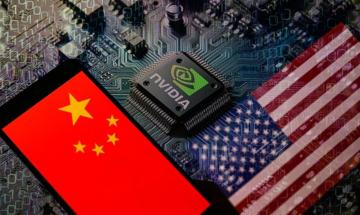
The Biden administration first imposed restrictions on American chip exports to China in 2022. The Trump administration expanded on these measures by banning Nvidia and AMD from selling chips to China.
However, last August, it partially reversed this, allowing Nvidia to sell its H200 chips under a 25% tax on its sales.
Despite these efforts, illegal attempts by Chinese actors to acquire American chips continue. In December, the US charged several entities with trying to smuggle Nvidia's most advanced chips by mislabeling them.
Contrary to Anthropic's assertion that China is catching up in AI, an ex-ByteDance engineer stated in April that China is actually falling further behind.
Now a research scientist and assistant professor at Peking University, Zhang Chi mentioned in a podcast that Chinese AI lacks high-quality data and access to cutting-edge chips.
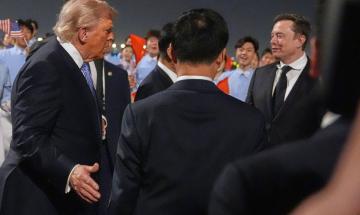
Anthropic's comments coincided with President Donald Trump's meeting with Chinese leader Xi Jinping, marking the first visit by a US president to China since Trump's 2017 trip.
Trump was accompanied by prominent US business figures, including Tesla CEO Elon Musk, Apple CEO Tim Cook, and Nvidia CEO Jensen Huang.