Humanoid warehouse workers: Silicon Valley's latest binge-watch trend
Viewers named the three humanoid robots sorting packages Bob, Frank, and Gary
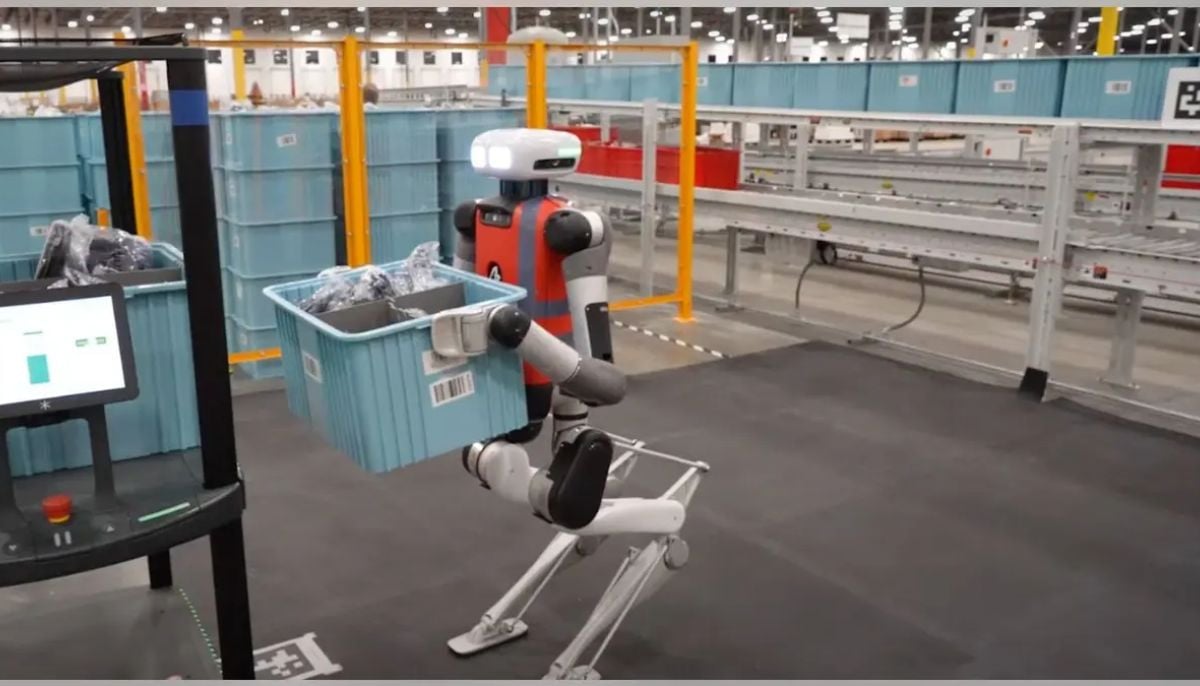
Silicon Valley's most-talked-about livestream this week features a humanoid robot working a shift in a warehouse.
It all started on Wednesday when Figure AI CEO Brett Adcock aimed to show doubters that his robots could carry out an eight-hour stretch of independent labour. Not long after, Figure AI positioned a film crew at its San Jose headquarters and began live-streaming a humanoid robot performing one of the most mundane tasks: sorting packages.
The web was intrigued. Millions watched as the robot picked up packages and placed them on a conveyor belt with the barcode facing down. Two humanoids stood by on chargers, ready to step in if the working robot's battery ran low.
One observer described the broadcast as "unexpectedly captivating" and requested a round-the-clock livestream. Meanwhile, investor Jason Calacanis wrote that "robotic ASMR is strangely soothing." As the livestream reached over 1.5 million views on X in its first eight hours, some viewers gave the three robots the names Bob, Frank, and Gary.
Figure AI achieved its goal of having the robot operate for eight hours without any "failures," according to Adcock, and decided to keep the stream going. By Thursday morning, after 24 hours, the humanoids had organised over 30,000 packages, attracting more than 3 million cumulative views.
This viral stream is more than just a robotics spectacle. For Figure AI, a startup nearing a $40 billion valuation, it serves as a public test for a future where humanoids can handle extended shifts in warehouses, factories, and eventually in homes. The demonstration provided investors and potential clients with a rare opportunity to see if the company's robots could consistently execute repetitive tasks.
It also highlighted the disparity between entertainment value and commercial readiness: although these humanoids might be approaching human speeds, experts believe there is a significant journey ahead before they can manage the complex environment of a logistical centre.
'A whole new economy'
Even tasks that are automatic to humans can present obstacles to robots, needing a dexterity, perception, stability, and decision-making that people rarely consider. This difficulty is part of why videos of humanoids doing everyday tasks are so fascinating.
Recently, Figure AI shared a video showing two humanoids making a bed together, while French startup Genesis AI, backed by former Google CEO Eric Schmidt, displayed a robot cooking an egg and playing the piano.
This week's livestream was tuned in by Figure supporters and board members Jesse Coors-Blankenship and Gregg Hill of Parkway Venture Capital, who mentioned they were viewing from their New York office and intended to celebrate this accomplishment later.
Coors-Blankenship revealed that the conveyor belt was a continuous loop, with the same parcels circulating with each cycle. The aim, he stated, was to prove to prospective customers that Figure AI's humanoids could reliably operate for extended periods, including 24-hour shifts.
"It's just something that's never been done before, except for maybe in a movie," Coors-Blankenship said. "It's so captivating because everyone's realising we're moving into a whole new economy."
The livestream raises stakes in the competition to create operationally viable humanoids. Figure AI faces stiff rivalry from Tesla, Agility Robotics, and China's Unitree.
"I imagine 50,000 of the viewers are Tesla investors," Hill remarked.
'More like a science project'
When questioned about Figure AI's livestream at an event in San Francisco on Wednesday night, Agility Robotics co-founder Jonathan Hurst said: "Well done. We accomplished that two years ago." The Oregon-established startup has placed its humanoid robot, Digit, with clients like Amazon, Schaeffler Group, and GXO, a logistics firm.
Last year, Figure AI attracted scrutiny after Fortune reported that Adcock appeared to exaggerate the company's work with its prominent client, BMW. Adcock contested the report, and the company has stated its earlier humanoid model spent 11 months at BMW's Spartanburg facility, conducting 10-hour shifts on weekdays and contributing to the production of over 30,000 X3 vehicles.
Figure AI CEO Brett Adcock is wagering on a future filled with "versatile humanoids." Bloomberg/Getty Images
Though Figure AI's livestream operated without major setbacks, the robots experienced some extended pauses and unusual actions like touching an arm to the helmet-like head. These activities sparked speculation that a remote human operator might be assisting the humanoids. Adcock insisted that the robots are entirely self-governed and make decisions based on what their cameras perceive.
Adcock explained that if a robot gets stuck, its AI model automatically resets itself, which is occasionally visible to viewers during the stream. Also, should a robot encounter a software or hardware problem, it autonomously exits for servicing, allowing another robot to continue the work.
"We haven't had a failure yet, but statistically we probably will at some point," Adcock wrote on X.
Human package sorters tend to take about three seconds per package, according to Adcock, and Figure AI's robots are now almost matching human levels. However, roboticist Ayanna Howard, dean of Ohio State University's College of Engineering, said speed is just one factor to consider for readiness.
Howard remarked that the livestream was noteworthy because the robot seemed to work continuously for such an extended period without failure. Yet, she noted that the humanoids appeared more like a "science experiment" than ready-for-deployment machines, citing accuracy problems observed during the stream, including incorrectly positioned packages on the conveyor belt and one package falling off the belt.
"It's not ready for prime time," Howard said, adding that the robot was performing only one small part of the package-sorting process.
"We're a long way away from a fully autonomous humanoid in a logistics center."
As of Thursday evening, the livestream continued, and the humanoids logged 30 hours of uninterrupted work. Adcock also introduced a new addition to the robot team: Rose.