Former RFK staffer reveals flirtatious bond with senator in new memoir
First Great Sorrow details Chaffee's years as an RFK staffer, from daily kisses to his assassination
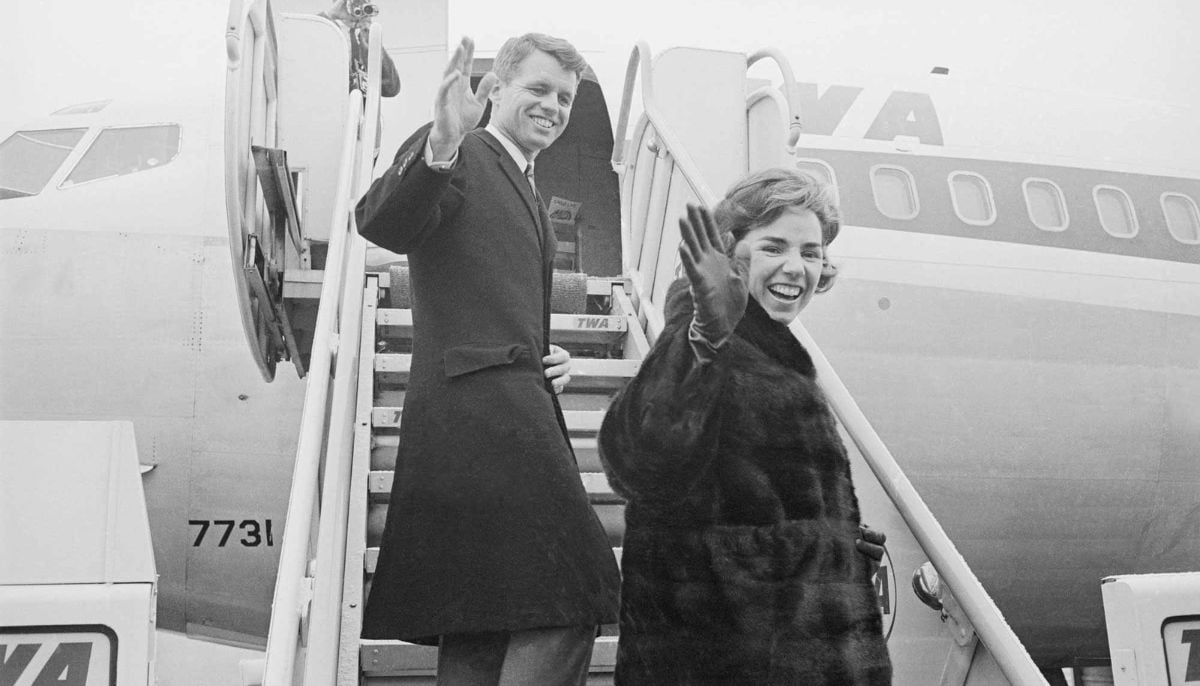
- Chaffee's memoir, First Great Sorrow, was published on Tuesday
- She joined RFK's Senate office in 1964 after a month of volunteering
- Chaffee asked Kennedy for a goodbye kiss on the cheek every day
A former Senate staffer who shared a remarkably close and flirtatious relationship with Senator Robert F. Kennedy has written a memoir recounting her years at his side — from the mailroom to the funeral train — and the one night she chose to walk away.
Donna Chaffee's book, First Great Sorrow: My Years With Robert F. Kennedy, published on Tuesday traces a journey that began with a single, world-altering moment: the assassination of President John F. Kennedy in Dallas, Texas, in November 1963. Chaffee was a senior at Hollywood High School in Los Angeles at the time.
"I decided that, in tribute to President Kennedy, I would devote my life to public service," she writes in the memoir.
"President Kennedy was my hero. When I went to college in Washington, D.C., I visited his grave at Arlington so often that one day, a guard asked me if I was a member of the family."
A foot in the door on Capitol Hill
Determined to be where the action was, Chaffee enrolled at George Washington University, deliberately arranging her timetable around early morning and evening classes so that her days remained free for work on Capitol Hill.
When JFK's younger brother, Robert F. Kennedy, won election as the junior senator from New York in 1964, she was determined to be one of the first volunteers at his office door.
That same boldness had already earned her a spot in the VIP section at President Lyndon B. Johnson's inauguration, and once again her instincts paid off.
After a month of volunteering and establishing herself within the RFK office, she was offered a paid role in the mailroom, where she helped manage the considerable volume of correspondence the senator received each day.
"There were 30 of us, which was large for a Senate staff at the time," Chaffee recalls, "but he took the time to get to know everyone." She was equally strategic about her own proximity to the senator, hand-delivering mail to his office and timing her departures so they would coincide with his.
On occasion, he offered her a lift home — sometimes accompanied by Providencia "Provi" Paredes, Jackie Kennedy's personal assistant and a trusted figure within the wider Kennedy circle, who had become a close friend of Chaffee's.
A daily ritual and a kiss on the cheek
It was during those rides home that a small but memorable ritual took shape. As she stepped out of the senator's two-door car onto the kerb, Chaffee began asking Kennedy the same question every single day.
"I have to admit that even after all these years, I'm reluctant to share this next bit. But here it goes."She would look him directly in the eye and ask with a coy smile: "Aren't you going to kiss me goodbye?" Each time, the senator obliged — a kiss on the cheek. "It became a routine," Chaffee writes. "But for me, it never felt routine. I can't deny it — it was exciting."
Reflecting on the dynamic now, Chaffee acknowledges the complications. "I know some might say there was a power dynamic, because he was my boss. But it never felt like that," she tells PEOPLE. She is equally candid about the age gap — she was fresh out of secondary school while RFK was in his forties — and the fact that he was married to Ethel, with whom he had eight of their eventual 11 children by the time he entered the Senate.
"Maybe if I had known her better, I wouldn't have been so flirtatious with her husband." As for Kennedy's own faithfulness, Chaffee is measured. "Ted [Kennedy] was the womanizer at that time. And everyone knows the stories about President Kennedy. But as far as I knew, he was faithful."
One night in San Francisco
Things remained at the level of a cheek kiss — until a night in San Francisco in 1966. By then, Chaffee had left Washington and transferred to the University of California, Berkeley, though she held an open invitation to return to the Kennedy office.
When RFK passed through Berkeley during campaigning for Democratic candidates in the 1966 midterm elections, she and a friend joined his staff for a gathering in his suite at the Fairmont Hotel.
During their reunion, Kennedy pulled her aside and asked if she would return to the suite after his dinner engagement. She agreed. As they parted, she repeated her familiar question.
"He looked at me again for what seemed like a long time, and then he moved in closer, took my face in his hands, and kissed me. This kiss was very different from the others — for one thing, it was on the lips. Afterwards, he held me close in his arms for a few moments. We exchanged some more words, and I left his suite."
But Chaffee did not go back. After a candid conversation with Kennedy's executive secretary, Angie Novello, she hailed a cab to Berkeley and left an apologetic message for the senator.
"Although I was madly in love with him — we all were — my feelings about him were also very complicated. I don't mean that I was in love with him in a purely romantic sense, even though that might be hard to believe given how I sometimes behaved. But it was different. I admired him so much, and he was the embodiment of everything I believed in, too. So it was difficult for me to look at him as just another man."
A final meeting and a promise he could not keep
Chaffee would see RFK twice more, both times during his 1968 campaign for the Democratic presidential nomination. By then she was engaged to her first husband, and the pair attended an event at the University of San Francisco, where Kennedy spotted her in the crowd and greeted her with an unprompted kiss on the cheek.
"It was the first time I didn't have to ask for it," she recalls. When that occasion was disrupted by protestors, they were unable to speak properly, so on the morning of 2 June 1968, Chaffee visited the Fairmont Hotel again — this time with her fiancé. With the help of Novello, they secured a brief meeting with Kennedy, who promised to attend their wedding later that year.
Just two nights later, in the early hours of 5 June 1968, RFK was shot at the Ambassador Hotel in Los Angeles, shortly after addressing supporters to celebrate victories in the California and South Dakota primaries.
He was killed by Sirhan Sirhan, a 24-year-old Palestinian-Jordanian man who later stated he carried out the assassination because of Kennedy's role in arms deals to Israel.
Grief, duty and the long aftermath
"Initially, I think I was in a state of shock. Then I shut down and got to work."
Chaffee helped Kennedy's staff co-ordinate funeral arrangements, travelling back to New York on the Kennedy plane and then joining the family and fellow mourners on the funeral train to Washington. Afterwards, she fell into a prolonged depression. She went ahead with her marriage that autumn — the wedding Kennedy had promised to attend — despite knowing the relationship would not endure.
"I think I did it just to have someone to take care of me." In time, the invitations to Hyannisport stopped arriving. But the grief never fully lifted.
"I've heard it's the same for lots of people, even those who didn't know him personally. Especially if you were around high school, college age at the time. His death deeply affected a lot of people of that generation."
Why she wrote the book
Chaffee is clear that First Great Sorrow is not a tell-all. It is, she says, a tribute — a window into RFK's life and legacy from someone who admired him deeply and continues to mourn his absence. Part of her motivation was the growing sense that his memory has been overshadowed.
"When you Google RFK now, it's three pages of RFK Jr. I don't even know if people realize he had a father!" In the memoir's epilogue, she writes that it is "not just Robert Kennedy's words that have inspired me over these many years. It is also the memory of his sacrifice." She concludes: "He was willing to give his life for what he believed in.
I will forever mourn his loss, but it is some comfort to me remembering those remarkable years that I spent with him. I tell my son that I don't regret being this old, because it allowed me the opportunity to breathe the same air as the Senator."