Teen mosque shooters motivated by hate, investigators say
Two teenagers involved in shooting at Islamic Centre of San Diego on Monday were consumed by shared animosity
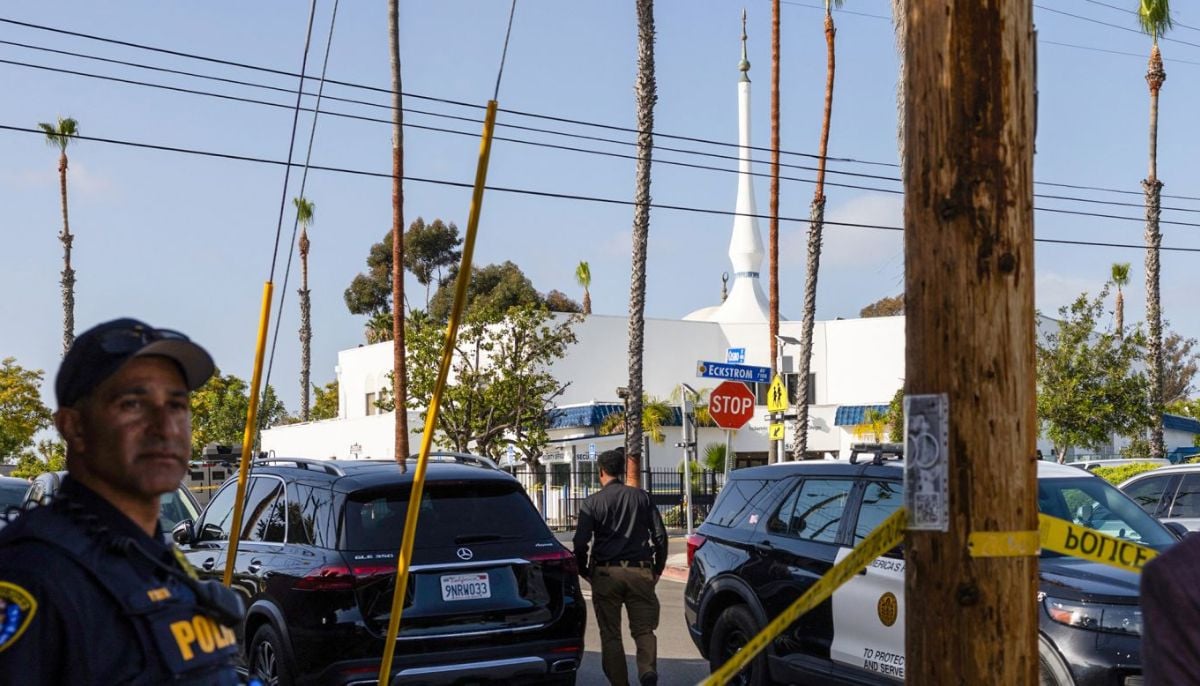
The two teenagers involved in the shooting at the Islamic Centre of San Diego on Monday were consumed by a shared animosity.
"These individuals harboured hatred indiscriminately," stated Mark Remily, the head of the FBI's San Diego Field Office, during a press gathering on Tuesday.
Officials believe the two connected online and realised they both lived in the San Diego vicinity before meeting face-to-face.
The pair, who became radicalised via the internet, embraced a hateful worldview, as reported by investigators. A document which the FBI described as a "manifesto" and reviewed by CBS News, seems to celebrate previous mass shooters and disseminate anti-Islamic, antisemitic, as well as racist and misogynistic discourse.
A note left by one of the teenagers suggested his readiness to sacrifice his life for his detestable ideology, according to a law enforcement source involved in the investigation.
One of the teenagers, 17-year-old Cain Clark, participated in the wrestling team at a local secondary school. The other, Caleb Vazquez, was 18 years old.
Authorities are examining evidence that implies the teens were inspired by numerous mass shooters, including the individual responsible for a 2019 mosque attack in Christchurch, New Zealand, which was live-streamed by the perpetrator.
The teenagers recorded their attack on Monday, producing a grisly ten-minute video that quickly circulated on a violent content-sharing website where users post graphic videos. CBS News has previously reported on earlier mass shooters who frequented the platform.
After their attack, which resulted in the loss of three lives — including a security guard who has been commended for saving many others — the footage depicts Clark, donned in camouflage, fatally shooting Vazquez before ending his own life.
The video also reveals weapons and equipment marked with neo-Nazi symbols.
Authorities stated that the teens had amassed 30 firearms and a crossbow, likely acquired from one of their parents.
An initial alert
The first alarm was raised at around 9:40 a.m. when the mother of one of the attackers contacted 911. She expressed her concern about her son's suicidal tendencies after realising several firearms and her vehicle were gone. Her son was dressed in camouflage, she added.
This information activated a threat warning, but no particular target was known, say law enforcement sources.
Two hours later, the two teens launched their assault on the mosque. They fatally shot a security guard outside, then proceeded into the building, which includes a school where over 100 children were present.
The attackers began searching from room to room, but fortunately, the guard, Amin Abdullah, had already initiated a lockdown signal and the children were elsewhere in the facility.
According to investigators, the teenagers then noticed two men in the car park through a window. They exited the mosque to attack and kill them before fleeing in their vehicle, shooting out of the window as they drove.
A few streets away, Clark shot his companion and then himself.
Exalting violence
The "manifesto" being examined by investigators spans 75 pages and appears to be a compilation of writings that have been circulating in the dark corners of the internet for a prolonged period, potentially assembled with AI assistance. CBS News has not independently confirmed the author of the document.
The document is infused with language linked to nihilistic violent extremism, with references to "accelerationism," which is one of the most aggressive white supremacist ideologies advocating for societal obliteration.
The footage discovered by investigators was uploaded to a website monitored by the FBI amid a troubling trend of youths engaging with the "True Crime Community" or TCC, an online movement that idolises mass shooters and promotes violence and self-damage.
A source familiar with the investigation speculates that the video was initially captured on Discord, a well-liked online social platform for gamers.
The source informed CBS News that the video seemed to have been posted by a user operating under the pseudonym "Otto." A CBS News investigation revealed that "Otto" had erased all of their posts on the platform.
A spokesperson for Discord has, as of yet, not provided a response to CBS News' inquiry for comment.